A colossal hidden structure deep beneath Hawaii may be quietly steering molten rock, helping keep one of Earth’s most famous hotspots alive.
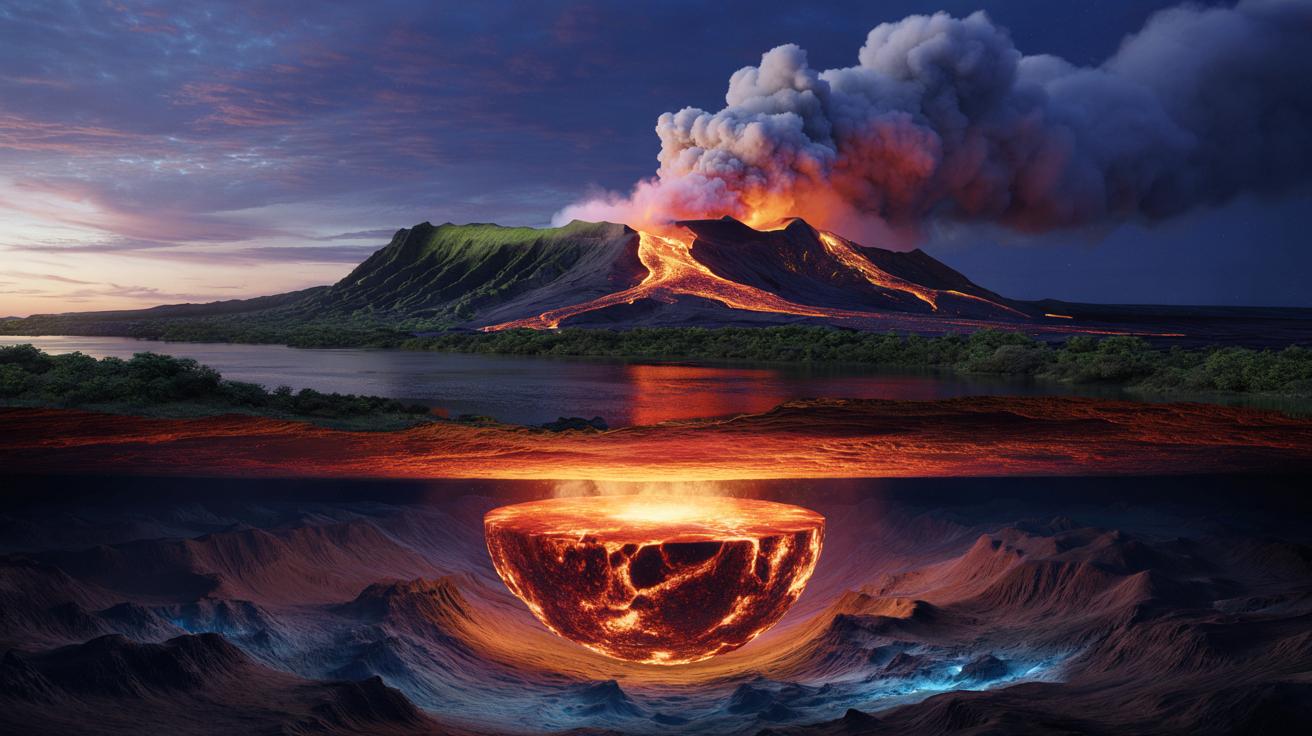
Buried nearly 3,000 kilometres below the Pacific, this iron-rich “mega-blob” seems to act like a heat lens at the base of the mantle, reshaping how geophysicists think about what powers long-lived volcanic chains such as the Hawaiian Islands.
A hidden giant at the edge of Earth’s core
For decades, seismologists have known that some patches at the base of the mantle slow seismic waves to a crawl. They call these regions ULVZs, for “ultra-low velocity zones”. One of the biggest sits directly beneath Hawaii, and it has now come under forensic scrutiny.
The structure lies around 2,900 kilometres down, right where the solid lower mantle meets the liquid outer core. At that depth, direct sampling is impossible, so researchers rely entirely on the way earthquake waves travel through the planet.
By watching how different types of waves, known as P waves (compression) and S waves (shear), speed up, bend or stall, scientists can infer what sort of material they have passed through. Strong slowdowns usually point to exotic compositions, high temperatures, or both.
This Hawaiian anomaly spans more than 1,000 kilometres across and up to 40 kilometres thick, making it a true “mega-ULVZ”.
The new work, led by researchers from the Carnegie Institution for Science, Imperial College London and Seoul National University, takes this a step further. They stitched together several seismic imaging techniques into a single 3D model, filtering data from many large earthquakes recorded around the Pacific.
The resulting image shows a broad, flattened block beneath Hawaii, rather than a narrow column. Its sheer lateral extent suggests it is a fundamental feature of the deep interior, not a local quirk.
Its position is equally striking. The mega-ULVZ sits almost exactly beneath the Hawaiian hotspot, the deep source that has been feeding lava to the islands for tens of millions of years. That alignment hints at a direct connection between the mysterious blob at the base of the mantle and the volcanic spectacle at the surface.
A solid, iron-rich block rather than a hidden magma pool
For years, many geophysicists pictured ULVZs as partially molten puddles of rock. The logic was simple: melt slows seismic waves, and the base of the mantle is extremely hot. The new study challenges that picture, at least beneath Hawaii.
➡️ A hidden tunnel has linked Earth to distant stars for millions of years
➡️ Human longevity depends as much on our genes as on our environment
➡️ Brain rejuvenation is measurable in adults who move more
➡️ When an oral infection sneaks into cancer development
➡️ In minutes, AI now does what medical teams needed months to complete
➡️ A study suggests cats can develop a form of dementia similar to Alzheimer’s
➡️ Physical exercise: a remedy as effective as medication against depression
➡️ Cannabis drinks open an unexpected path in the fight against alcohol
By comparing exactly how much P and S waves slow as they pass through the region, the team calculated a key metric: the RS/P ratio, which measures the relative reduction of S-wave speed compared with P-wave speed.
Numbers between about 1.0 and 1.3 emerged for the mega-ULVZ. That range fits best with a fully solid material that is unusually dense and iron-rich, rather than with molten rock.
The structure appears to be a rigid, iron-heavy block, not a mushy magma reservoir lurking at the base of the mantle.
Laboratory experiments on minerals stable at extreme pressures point to one likely candidate: magnesiowüstite, a high-pressure oxide composed of magnesium and iron, written chemically as (Mg,Fe)O. When loaded with more than roughly 20% iron oxide by volume, it becomes both very dense and an excellent conductor of heat.
That high iron content would make the Hawaiian mega-ULVZ compositionally distinct from the surrounding mantle, rather than just a hotter patch of the same rock. It hints at a relic reservoir that has managed to avoid being thoroughly mixed by convection for billions of years.
How a buried blob can stabilise a hotspot
The stability of the Hawaiian hotspot has long puzzled geologists. As the Pacific plate drifts northwest, the hotspot stays put, punching out a chain of islands and seamounts that tracks plate motion over at least 70 million years. Something at depth appears to keep the underlying mantle plume rooted.
The mega-ULVZ offers a compelling mechanism. Because the iron-rich block conducts heat so well, it likely channels thermal energy from the outer core into a focused patch at the base of the mantle. That extra heat can make the mantle above slightly hotter and more buoyant, encouraging the rise of a plume.
An iron-rich mega-blob may act as a thermal lens, concentrating core heat and pinning the Hawaiian plume in place.
The density of the block could also slow nearby mantle circulation. With convection damped locally, the base of the plume has less tendency to wander or be shredded by surrounding flow.
Together, these effects offer a physical reason why the Hawaiian hotspot, and perhaps a few others, remain remarkably stable compared with more transient volcanic features along subduction zones or mid-ocean ridges.
What is a mantle plume, in plain terms?
A mantle plume is often likened to a lava lamp. Heat from below warms a patch of solid rock, making it slightly less dense. That buoyant material rises slowly in a column, bringing heat from deep within the planet towards the surface.
- At the top of the plume, the hot rock begins to melt.
- That melt feeds volcanoes at the surface.
- As tectonic plates move, the surface expression of the plume shifts, creating chains of volcanoes.
Hawaii, Iceland, and Yellowstone are among the best-known candidates for plume-fed hotspots, though each may operate differently.
Ancient origins: leftovers from Earth’s violent youth?
Where did this iron-rich mega-blob come from? The study sets out a couple of leading ideas, each tied to a different chapter of planetary history.
One scenario traces the block back over four billion years, to a time when Earth’s outer layers were likely covered by a deep “magma ocean”. As this global melt cooled and crystallised, denser, iron-heavy minerals would have sunk towards the base of the mantle, forming thick, chemical “sediments” on the core–mantle boundary.
The Hawaiian mega-ULVZ could be one such sediment patch: a leftover from that early differentiation, still perched at the bottom of the mantle, largely unmixed since the planet’s youth.
A second scenario points to long-term plate tectonics. Over hundreds of millions of years, slabs of oceanic crust have plunged into the mantle at subduction zones. As they descend, they can release iron-rich materials that drift downwards and accumulate at the core–mantle boundary, gradually building up dense piles.
Both routes, early magma ocean or recycled slabs, lead to the same implication: some deep mantle regions preserve very old chemical signatures. The Hawaiian mega-ULVZ might carry a record of conditions either shortly after Earth’s formation or during the early days of plate tectonics.
Global echoes beneath Samoa, the Atlantic and beyond
Hawaii is not the only place where ULVZs show up. Smaller anomalies have been detected beneath Samoa in the South Pacific and beneath parts of the South Atlantic, also close to suspected hotspots.
If these regions share the same sort of iron-rich, solid composition, they might represent a network of deep anchors for mantle plumes worldwide. That would recast hotspots as surface expressions of a much larger, structured system at the core–mantle boundary, rather than isolated accidents of melting.
| Region | Type of deep anomaly | Associated surface feature |
|---|---|---|
| Hawaii | Mega-ULVZ | Hawaiian hotspot and volcanic chain |
| Samoa | ULVZ | Samoan hotspot and seamounts |
| South Atlantic | ULVZ patches | Hotspot tracks on Atlantic seafloor |
These deep structures also matter for the planet’s thermal evolution. By shaping how and where heat escapes from the core, they could influence the geodynamo that generates Earth’s magnetic field, as well as long-term cooling rates of the interior.
Key terms that make the deep Earth easier to follow
The jargon around deep Earth studies can feel opaque, so a few definitions help.
- Core–mantle boundary: The interface between the rocky mantle and the molten outer core, at around 2,900 kilometres depth.
- ULVZ: Ultra-low velocity zone; a patch where seismic waves slow sharply, hinting at unusual composition or temperature.
- Magnesiowüstite: A dense oxide mineral stable at high pressure, made of magnesium and iron, with strong thermal conductivity.
- Hotspot: A persistent area of volcanic activity not directly tied to plate boundaries, often linked to deep mantle plumes.
Behind each term lies a set of measurements rather than direct observation. No probe has ever reached the mantle, let alone the core. Everything comes from how the planet rings like a bell after large earthquakes and from lab experiments that squeeze minerals to extreme pressures and temperatures.
What this means for future risks and research
For people living in Hawaii, the mega-blob itself does not change day-to-day volcanic risk. The block sits thousands of kilometres below any magma chamber that could threaten communities. Eruptions are controlled mainly by shallower processes in the upper mantle and crust.
Where it matters is in long-term forecasting and global comparisons. A better handle on plume stability could refine expectations of where new volcanic chains might appear on the seafloor, how long existing hotspots will stay active, and how heat loss from the core might evolve over geological time.
Future studies will likely combine even denser seismic networks, improved computer simulations of mantle flow, and more sophisticated experiments on iron-bearing minerals. As models sharpen, the Hawaiian mega-ULVZ could shift from being a single mysterious blob to a template for understanding deep structures across the planet.