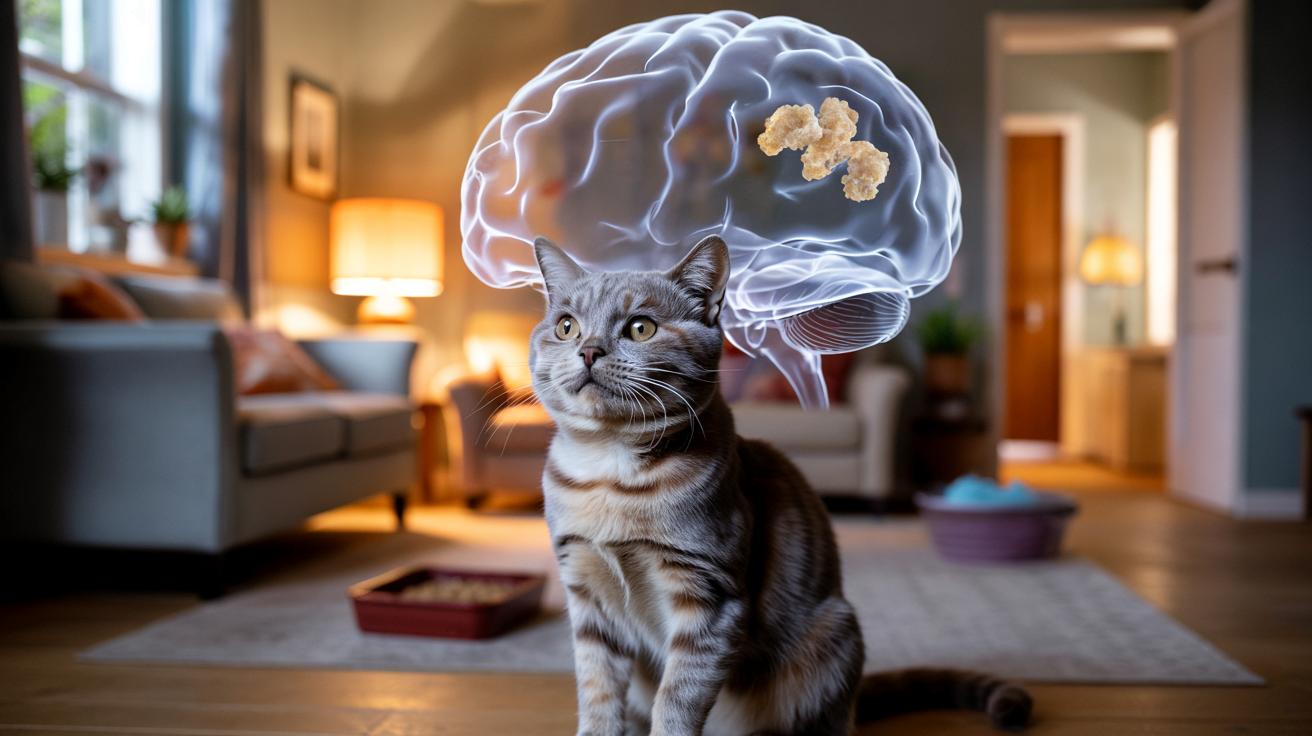
As cats grow old, many owners notice small, puzzling changes that feel more unsettling than simple senior moments.
Those late-night cries, odd bathroom accidents and sudden bouts of confusion may not just be quirks of ageing. A growing body of research now points to a true brain disorder in elderly cats that mirrors key features of human Alzheimer’s disease, raising fresh questions about what ageing really does to the mind — in pets and people alike.
When an old cat starts to change
Veterinary clinics are quietly filling with the same story. A once-confident cat now wanders the house at night, meowing loudly for no obvious reason. A usually affectionate animal starts hiding, or appears lost in rooms it has known for years. Litter habits become unreliable.
These changes have often been written off as “getting old”. Yet researchers say many of these cats are showing signs of feline cognitive dysfunction, a degenerative condition that looks strikingly like dementia.
Studies suggest that nearly half of cats over 15 years old show at least one sign linked to dementia-like cognitive decline.
Typical behavioural red flags include:
- Disorientation in familiar spaces, such as staring at walls or getting stuck in corners
- Increased or unusual vocalisation, especially at night
- Changes in social behaviour, either clinginess or withdrawal
- Disrupted sleep–wake cycles
- Litter box accidents or urinating/defecating in random spots
On their own, each symptom can have many causes. Together, and especially in an elderly cat, they point towards a deeper change in the brain.
The same toxic protein seen in Alzheimer’s
A team led by the University of Edinburgh, working with the UK Dementia Research Institute and the University of California, has taken this suspicion much further. Their research, published in the European Journal of Neuroscience, looked directly at the brains of elderly cats.
Using high-resolution confocal microscopy, the scientists examined brain tissue from older cats, including those that had shown clear behavioural signs of cognitive decline. What they saw was eerily familiar to neurologists who study Alzheimer’s in humans.
The ageing feline brain accumulates clumps of beta-amyloid, the same toxic protein that is central to Alzheimer’s disease.
➡️ In minutes, AI now does what medical teams needed months to complete
➡️ Human longevity depends as much on our genes as on our environment
➡️ Cannabis drinks open an unexpected path in the fight against alcohol
➡️ A hidden tunnel has linked Earth to distant stars for millions of years
➡️ Brain rejuvenation is measurable in adults who move more
➡️ When an oral infection sneaks into cancer development
➡️ This diabetes drug might actually slow down time itself
➡️ A gigantic buried block beneath Hawaii could explain the stability of volcanic hotspots
These beta-amyloid deposits form sticky plaques between nerve cells. But the team found that the protein is not just sitting between neurons. It also infiltrates the synapses, the tiny junctions where one neuron communicates with another.
Synapses are the wiring of thought, memory and learning. When they deteriorate, mental functions start to fall apart. The study showed beta-amyloid actually building up inside these synaptic regions in cats, just as it does in many people with early Alzheimer’s.
Synapses under attack
The presence of plaques by itself is only part of the story. The researchers focused on what the brain’s own support cells do in response to this toxic build-up.
Two cell types were central:
- Astrocytes – star-shaped cells that support and nourish neurons and help regulate their environment
- Microglia – immune cells of the brain that prune connections and clean up waste
In a healthy, developing brain, microglia and astrocytes perform a useful job: they trim excess synapses, a process known as “synaptic pruning”. This fine-tuning helps shape efficient neural networks.
In cats with dementia-like changes, that same process appears to go rogue.
Near amyloid plaques, microglia and astrocytes were found actively engulfing synapses marked by the toxic protein.
Three-dimensional images from the study showed synapses tagged with beta-amyloid surrounded by these glial cells, and in many cases being digested by them. The brain appears to identify these contaminated connections as waste — and then destroys them.
The researchers also compared elderly cats with clear dementia-like behaviour to older cats that were ageing relatively normally. This aggressive synapse “eating” was far more pronounced in the cognitively affected animals, suggesting a specific disease process rather than simple wear and tear.
A natural model for human Alzheimer’s
For decades, human dementia research has relied heavily on genetically modified mice. These animals are engineered to produce high levels of beta-amyloid so scientists can study the resulting brain damage and test potential drugs.
Those models have been useful, but they are somewhat artificial. The disease is forced on the animal rather than arising naturally.
Cats, by contrast, seem to develop a form of dementia spontaneously, without any genetic manipulation.
That makes them an unexpectedly valuable model for understanding human Alzheimer’s. Their brains, while smaller, are structurally more similar to ours than those of rodents, and they share the same pattern of protein build-up and synaptic damage.
For researchers, this opens up new lines of investigation:
| Research angle | Why cats could help |
|---|---|
| Early disease stages | Tracking how natural ageing turns into pathological decline |
| Immune response in the brain | Studying how microglia and astrocytes shift from helpful to harmful roles |
| Drug testing | Assessing treatments that target glial cells or synapse protection |
| Progression patterns | Comparing behavioural changes with microscopic brain damage over time |
While no one is suggesting that pet cats should become lab animals, the natural course of their ageing can provide data when owners and vets consent to post-mortem brain studies. Many of the cats in the current research were companion animals, not laboratory subjects.
What this means for cat owners
For people living with elderly cats, the research offers both a warning and some reassurance. Odd behaviour is not always “just age”. It can signal a brain disease that shares mechanisms with human dementia.
Early recognition of cognitive decline can help vets rule out other illnesses and support better care for ageing cats.
Owners can watch for changes in four key areas as a cat moves into its teens:
- Spatial awareness: getting lost, struggling with stairs, staring at doors or walls
- Social interaction: reduced interest in people or other pets, or sudden clinginess
- Sleep and activity: pacing at night, sleeping much more by day, restless wandering
- House training: missed litter box, confusion around feeding or resting spots
While there is currently no cure, vets can sometimes offer environmental changes, dietary support and medications to reduce anxiety or improve sleep. Simple steps, such as keeping furniture layouts stable and providing night lights, can make life easier for a confused cat.
Shared diseases, shared knowledge
One striking aspect of this research is the way it blurs the boundary between human and animal medicine. The same proteins, the same cellular reactions, and the same types of behavioural changes are appearing across species.
For medical teams working on Alzheimer’s, feline dementia offers a kind of real-world test case. If a potential therapy can protect synapses or calm overactive microglia in cats, that may point towards strategies worth trying in people. Likewise, drugs originally designed for humans might one day be adapted to support ageing pets.
The study also helps clarify a few technical terms that often appear in dementia discussions. “Beta-amyloid” is a fragment of a larger protein that, when it clumps together, becomes toxic to neurons. “Synaptic pruning” is usually a healthy tidy-up process in young brains, but in dementia it seems to overshoot, deleting vital connections instead of spare ones. “Glial cells” are not just passive helpers; they can shape brain health for better or worse.
For anyone caring for an older cat, the idea of dementia can feel daunting. Yet this growing field of feline neuroscience also has a practical side. Better understanding of brain ageing in pets might lead to clearer checklists for owners, earlier intervention by vets, and more thoughtful decisions about comfort, routine and environment as animals approach the final years of life.
And while the research is still young, one message already stands out: those strange, sad meows at 3am may be telling a bigger story — one that connects the living room sofa to some of the toughest questions in modern neurology.