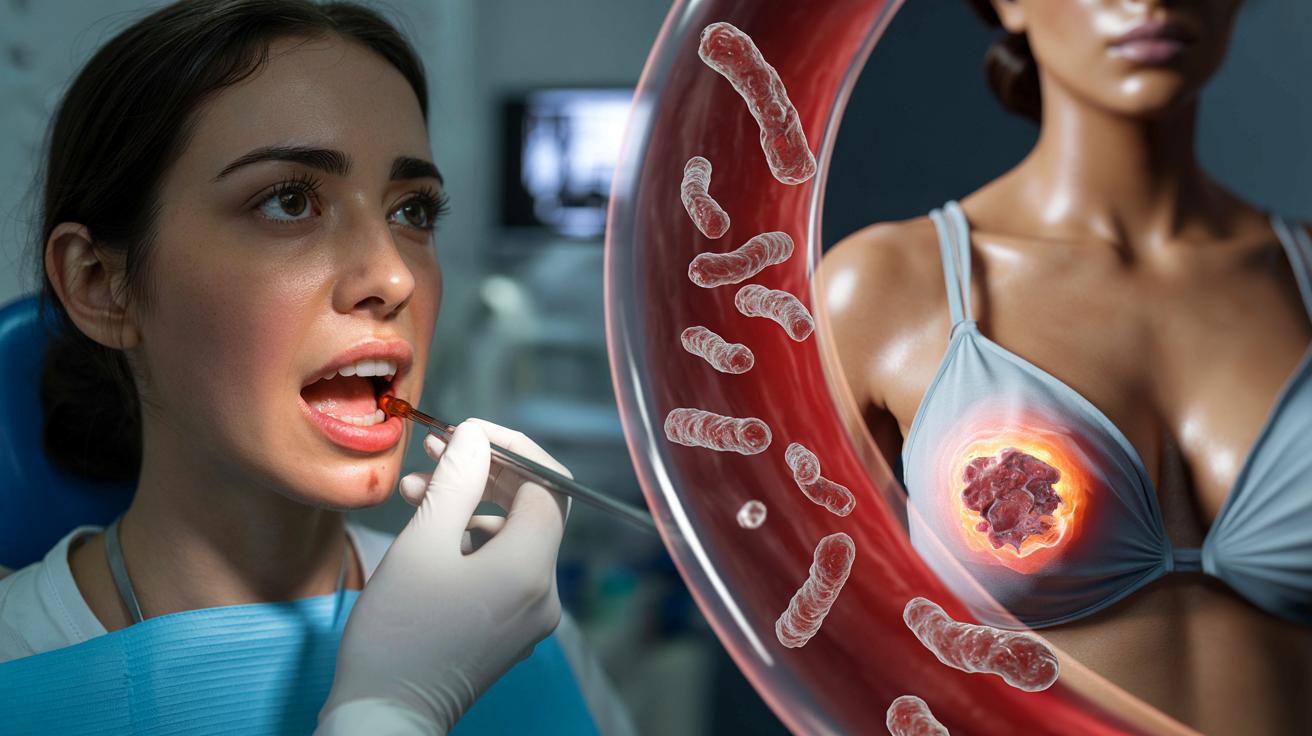
In a place usually linked with cavities and bad breath, scientists have spotted something far more unsettling quietly unfolding.
New research suggests that a common oral infection might not stay in the mouth at all. Instead, certain bacteria appear able to slip into the bloodstream, reach the breast, and nudge healthy tissue towards the first dangerous steps of cancer.
From gums to tumours: a surprising bacterial journey
For years, dentists and doctors treated the mouth as a more or less separate ecosystem. Tooth decay, bleeding gums, maybe a root canal, and that was it. The bacteria stayed put. That idea is now starting to crack.
One culprit in particular, Fusobacterium nucleatum, is under scrutiny. This anaerobic bacterium is well known in periodontitis, a chronic gum disease linked with tooth loss. Researchers at the Johns Hopkins Kimmel Cancer Center have now shown that it can move beyond the mouth, travel via the blood, and settle in breast tissue.
The team used a combined experimental model, working with human breast cancer cells in the lab and genetically modified mice. When they injected F. nucleatum directly into the mammary gland of mice, the tissue changed in troubling ways.
Inflammation ramped up, pre-cancerous lesions appeared, and cells started to divide faster than they should, all before any obvious tumour emerged.
Those early changes, the scientists argue, look like the opening moves of carcinogenesis: not a full-blown cancer yet, but the landscape being reshaped to welcome one.
How an oral microbe helps set the stage for cancer
The study, published in the journal Cell Communication and Signaling, goes beyond simple association. It maps out how the bacterium might help push cells along the cancer pathway.
In breast tissue, F. nucleatum appears to do two dangerous things at once. First, it triggers chronic inflammation. Immune cells rush in, releasing signals and reactive molecules. Those molecules, including reactive oxygen species, can damage DNA.
Second, the bacterium seems to disturb how cells repair that DNA damage. The researchers observed that some repair systems kicked in quickly but sloppily. One mechanism, known as non-homologous end joining, essentially tapes broken DNA ends back together without using a proper template.
➡️ In minutes, AI now does what medical teams needed months to complete
➡️ A study suggests cats can develop a form of dementia similar to Alzheimer’s
➡️ This diabetes drug might actually slow down time itself
➡️ A gigantic buried block beneath Hawaii could explain the stability of volcanic hotspots
➡️ Human longevity depends as much on our genes as on our environment
➡️ Brain rejuvenation is measurable in adults who move more
➡️ Cannabis drinks open an unexpected path in the fight against alcohol
➡️ A hidden tunnel has linked Earth to distant stars for millions of years
Fast but imperfect DNA repair raises the odds of mutations, especially when combined with constant inflammatory stress.
Mutations that affect genes controlling cell growth, division or death can gradually transform a normal cell into a malignant one. In that context, the presence of a persistent bacterial guest becomes far from harmless.
BRCA1 mutations and a dangerous partnership
The story looks even more worrying in people already carrying a genetic risk. The Johns Hopkins team focused on cells with mutations in the BRCA1 gene, a key player in DNA repair. Women with harmful BRCA1 variants already face a higher risk of breast and ovarian cancers.
These BRCA1-mutated cells reacted differently to the bacterium. They produced more sugars on their surface, effectively creating a sticky coating. F. nucleatum uses this sugary layer to latch on and stay put.
Once attached, the bacterium wasn’t easily removed. Even as cells divided, the microbial passenger could persist across several generations of daughter cells.
In BRCA1-mutated cells, F. nucleatum acts like an environmental amplifier, stacking extra risk on top of a genetic vulnerability.
Over time, oxidative stress, faulty DNA repair and repeated cell division accumulate. The result is a cell population far more prone to tipping into cancer than in a healthy, bacteria-free environment.
Oral health as a breast cancer prevention tool
This work feeds into a growing body of evidence linking gum disease with breast cancer. Observational studies have repeatedly found higher cancer rates in women with chronic periodontitis. What was missing was a plausible biological chain connecting mouth and breast.
By showing the bacterium in breast tissue and tracking its effects on DNA and cell behaviour, this research turns a loose association into a concrete pathway. The idea that a “simple” oral infection can influence cancer risk in distant organs no longer looks far-fetched.
For oncologists and public health specialists, that raises immediate questions about prevention strategies, especially for women already flagged as high risk.
What this could mean for women at higher risk
Women with BRCA1 or BRCA2 mutations already undergo enhanced screening, such as earlier and more frequent mammograms or MRI scans. Some opt for preventive mastectomy or hormonal interventions.
If oral bacteria like F. nucleatum prove to be repeat offenders, dental care could join that list of protective steps.
- Regular dental check-ups and professional cleanings to limit gum inflammation.
- Early treatment of bleeding gums, abscesses, and periodontitis.
- Closer collaboration between dentists, GPs and breast specialists for women with strong family histories.
- Patient information on the possible systemic impact of chronic oral infections.
This does not turn brushing into a magic shield against breast cancer. But it reframes oral hygiene as a part of risk management, especially when genetics already load the dice.
The oral microbiome reaches far beyond the mouth
The Johns Hopkins findings sit within a broader shift in how scientists think about microbes in general. The gut microbiome received much attention over the past decade. Now the oral microbiome is having its moment.
Bacteria from the mouth have already been implicated in heart disease, adverse pregnancy outcomes and certain digestive cancers. Chronic gum disease has been tied to higher risk of stroke and type 2 diabetes.
The mouth is emerging as a key gateway for microbes that can influence distant organs, from arteries to breast tissue.
Researchers suspect that F. nucleatum may not be the only oral species capable of reaching and shaping tumour environments. The current work could be a starting point rather than a unique case.
What scientists are watching next
Several questions now push the field forward:
- Which other oral bacteria can travel and colonise breast or other tissues?
- Are there specific “signatures” of oral microbes in different types of tumours?
- Could antibiotics, vaccines or targeted probiotics reduce harmful colonisation without causing resistance or collateral damage?
- Might saliva tests one day help assess cancer risk through microbial fingerprints?
Teams are also looking at whether lifestyle factors that alter the oral microbiome — smoking, diet, alcohol, certain mouthwashes — interact with inherited cancer risk genes.
Making sense of the science: key terms and practical angles
A few concepts sit at the heart of this research and are likely to crop up in future headlines.
| Term | What it means |
|---|---|
| Microbiome | The community of microbes (bacteria, fungi, viruses) living in a particular area, such as the mouth or gut. |
| Carcinogenesis | The stepwise process by which normal cells gradually become cancerous. |
| BRCA1 | A gene involved in repairing damaged DNA; harmful variants raise breast and ovarian cancer risk. |
| Oxidative stress | An imbalance between reactive molecules and the body’s ability to neutralise them, leading to cell and DNA damage. |
| Periodontitis | Advanced gum disease that damages the tissues and bone supporting the teeth. |
Consider a practical scenario. A 35-year-old woman learns she carries a BRCA1 mutation. Her care team already proposes closer breast screening. With findings like those from Johns Hopkins, that team might also suggest an evaluation by a periodontist, not just a routine dentist, to check for deeper gum disease. Treating an underlying oral infection would then be part of an integrated strategy to reduce cumulative risk.
A different case: a woman with no known genetic mutation but with long-standing severe gum disease, smoking, and a family history of cancer. Individually, each factor raises concern. When combined with the possibility of bacterial spread from mouth to breast, they start to look like overlapping risks that could be lowered with coordinated care — smoking cessation, periodontal treatment, and regular screening adapted to personal history.
As research advances, public health recommendations may shift from treating oral health as purely cosmetic to viewing the mouth as an early intervention point. The idea that your toothbrush, dental appointments and gum health might play a role in cancer prevention is likely to sit uncomfortably at first. Yet it opens up a new, surprisingly accessible lever for people trying to tilt the odds in their favour.