<strong>For decades, astronomers pictured our Solar System adrift in a quiet patch of space.
New X‑ray data say otherwise.
Fresh observations suggest that our corner of the Milky Way is stitched together by vast, invisible corridors of hot gas, carved by ancient stellar explosions and quietly funnelling energy around us.
A hot galactic bubble around the Solar System
Our Solar System does not sit in ordinary interstellar space. It resides inside a huge cavity of thin, superheated gas known as the Local Hot Bubble. This bubble stretches for roughly 300 light-years and has likely been here for millions of years.
A series of violent supernova explosions long ago blasted away much of the surrounding gas and dust. Those blasts left behind a swollen shell and a low-density interior filled with plasma at more than a million degrees.
The Local Hot Bubble is a fossil scar from multiple dead stars, still shaping the environment that Earth travels through today.
For a long time, astronomers treated this bubble as a bit of an oddity: too hot, too empty, and strangely shaped. That view is now changing thanks to eROSITA, an X‑ray telescope flying on the Russian-German SRG spacecraft.
By scanning the entire sky in soft X‑rays, eROSITA has built the sharpest map yet of the high‑energy glow around us. The data reveal a striking contrast: the northern sky appears cooler, while the southern side reaches about 122 electronvolts, or roughly 1.4 million kelvin. That thermal imbalance hints at a turbulent past, with different regions heated in different episodes.
A hidden tunnel linking Earth to distant stellar regions
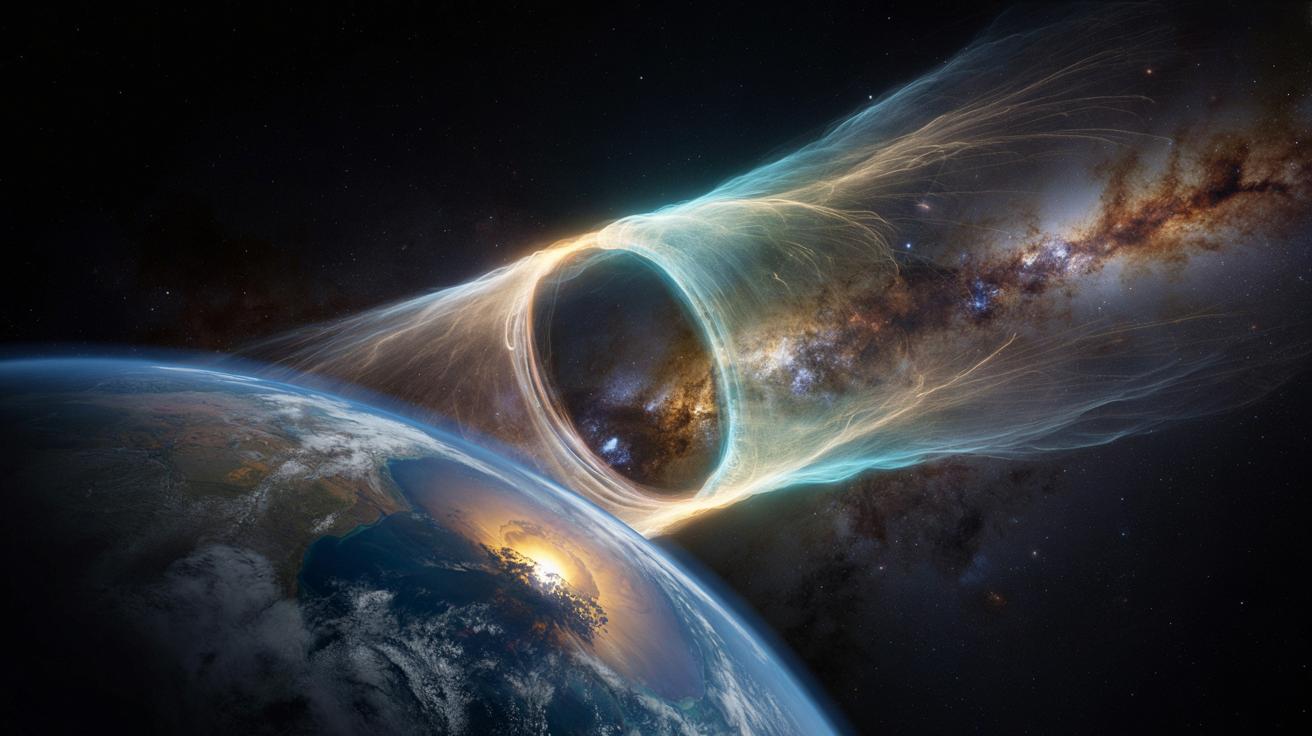
Inside this chaotic neighbourhood, scientists have now identified something even more intriguing: elongated cavities of hot plasma that stretch away from the Local Hot Bubble like corridors.
These features behave like natural tunnels in the interstellar medium. Rather than isolated pockets, they look like channels connecting our bubble to other active zones of star formation and past explosions, especially in the directions of the constellations Centaurus and Canis Major.
Earth sits near the entrance of a vast, hot tunnel that appears to link our region directly to faraway stellar nurseries.
➡️ A gigantic buried block beneath Hawaii could explain the stability of volcanic hotspots
➡️ Brain rejuvenation is measurable in adults who move more
➡️ When an oral infection sneaks into cancer development
➡️ In minutes, AI now does what medical teams needed months to complete
➡️ This diabetes drug might actually slow down time itself
➡️ Physical exercise: a remedy as effective as medication against depression
➡️ Human longevity depends as much on our genes as on our environment
➡️ Cannabis drinks open an unexpected path in the fight against alcohol
The analysis suggests these are not rare quirks. They may be pieces of a much wider network of cavities and channels sculpted by past supernovae and sustained by powerful stellar winds. Over time, expanding bubbles from dying stars punch holes into neighbouring dust clouds, merge with other bubbles, and leave behind a tangled system of conduits.
Inside these tunnels, the gas is extremely hot, extremely thin, and relatively free of dust. That combination makes them permeable to radiation and energetic particles. Instead of an empty and uniform space between stars, we get a more intricate picture: interconnected regions with distinctive temperatures, densities and flows.
A new, dynamic map of “empty” space
The eROSITA findings challenge a basic mental image of the Milky Way. Interstellar space is not a smooth fog dotted with random clouds. It looks more like a patchwork of cavities and channels, where energy and matter travel along preferred routes.
These tunnels of plasma might act as highways for several key processes:
- transport of cosmic rays across large distances
- movement of dust grains and heavy elements from one region to another
- pressure flows that can push, squeeze, or erode nearby molecular clouds
- thermal contact between otherwise separated stellar bubbles
That last point matters because molecular clouds are the cold, dense regions where new stars are born. If hot tunnels press against these clouds, they can compress the gas in some places and disperse it in others, influencing where and when star formation kicks off.
The shape of “nothingness” between stars can indirectly decide where the next generations of stars, and planets, will form.
By treating these corridors as distinct structures, eROSITA gives researchers a starting point for a three‑dimensional map of the local interstellar medium. Instead of just cataloguing individual stars and clouds, astronomers can begin charting the vast, invisible plumbing between them.
What exactly is a galactic “tunnel”?
In this context, a tunnel is not a solid tube or a sci‑fi wormhole. It is a region of space where conditions differ sharply from the surroundings: hotter, thinner, and shaped by past explosions into a roughly elongated form.
Three physical quantities describe these structures:
| Property | In a hot tunnel | Typical effect |
|---|---|---|
| Temperature | ~1–1.5 million K | Strong X‑ray emission, efficient heating |
| Density | Extremely low | Fewer collisions, long travel paths for particles |
| Pressure | Comparable to surroundings | Helps balance against cooler, denser regions nearby |
Because density is so low, X‑rays can travel through these regions without being absorbed quickly, which is why instruments like eROSITA can trace their outlines. The surrounding dust acts like a curtain, making the contrast even sharper in X‑ray maps.
Why Earth’s position inside a tunnel matters
Living inside a bubble that connects to such a tunnel has several implications for our planet and for astrophysics more broadly.
Cosmic rays and space weather
Cosmic rays are high‑energy particles that zip through the galaxy. Their paths bend in magnetic fields and are affected by the structure of the interstellar medium. If our Solar System lies near a channel of hot, low‑density plasma, that could influence how cosmic rays reach us.
Some models suggest that open corridors may give cosmic rays easier access along certain directions, while dense clouds can shield or scatter them. Because cosmic rays play a role in atmospheric chemistry and radiation levels for spacecraft, understanding these routes is useful for long‑term planning of deep-space missions.
Star formation in our galactic neighbourhood
The Local Hot Bubble touches several nearby star-forming regions. Tunnels that branch out from it may carry heat and shock waves into the outskirts of cold clouds. That energy can compress clumps of gas and trigger collapse, or it can tear clouds apart and halt star formation in particular zones.
By including these structures in computer simulations, astrophysicists can test how chains of supernovae over tens of millions of years might orchestrate waves of star formation across a patch of the Milky Way.
From static maps to living simulations
The next step is to move from still images to time‑evolving models. With eROSITA’s X‑ray data as a backbone, teams can build 3D simulations showing how bubbles expand, overlap and carve new tunnels in the interstellar medium.
A typical scenario looks like this: a massive star cluster forms, a few of its biggest stars explode as supernovae, their shock waves merge into a common cavity, and the bubble pushes into weaker regions of the surrounding gas. When that bubble reaches the thin boundary of a neighbouring cavity, it can puncture it and form a channel, much like merging soap bubbles.
Over millions of years, repeated events stitch together a loose lattice of hot corridors. Our own Local Hot Bubble appears to be just one cell in that lattice.
Key terms that help make sense of the picture
For readers trying to keep track of the jargon, a few concepts are worth pinning down.
- Interstellar medium: the mix of gas, dust, magnetic fields and particles that fills the space between stars.
- Plasma: gas so hot that atoms fall apart into charged particles, letting it carry currents and respond strongly to magnetic fields.
- Supernova: the violent death of a massive star, which can outshine a whole galaxy for a short time and launch shock waves across light‑years.
- Soft X‑rays: relatively low‑energy X‑rays, especially good at tracing million-degree gas in the interstellar medium.
Grasping these ideas helps frame why a “tunnel” here is not mystical at all. It is a natural outcome of gravity, nuclear fusion in stars, and the explosive release of energy when those stars die.
What this means for future research and for us
As more data from eROSITA and upcoming missions are analysed, astronomers expect to refine the shape and length of the local tunnel network. That will feed into better models of cosmic-ray transport, the Sun’s galactic environment, and the long-term conditions that surround our Solar System.
For anyone looking up at the night sky, the idea is quietly striking: while planets orbit the Sun and the Sun orbits the galaxy, the entire system is also drifting inside a vast, ancient tunnel of hot gas, linked to distant stellar regions we can only see as faint smudges of light. That hidden architecture has been there for millions of years, silently channelling energy past our cosmic doorstep.